Wings of Heroes: Flying Games
- 4.3
- Rating
- 5.00M
- Installs
- Free
- Price
 Analysis by App-foxy
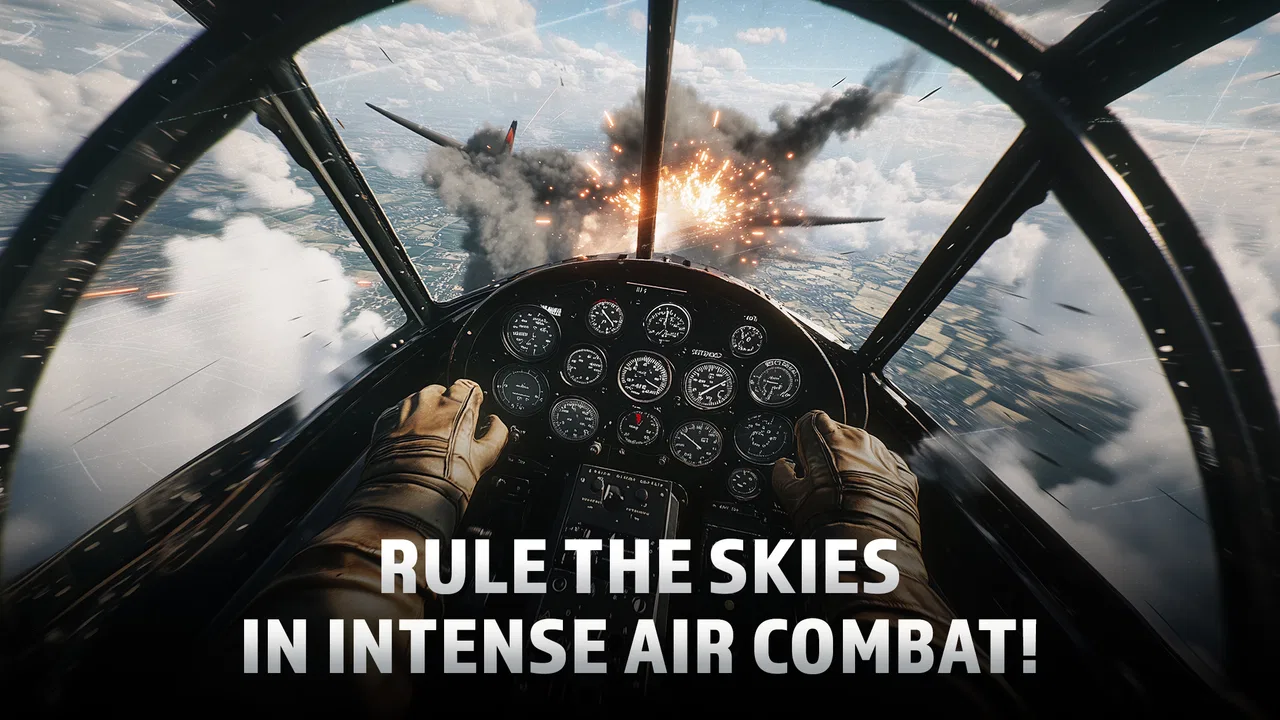
I approached Wings of Heroes: Flying Games expecting a quick arcade flight game, but it sits in a more interesting space. It is a free simulation game from RORTOS that puts you in the cockpit of a warplane and focuses heavily on action, dogfights, and online competition. The flying is accessible enough to understand quickly, yet the battles still reward patience, positioning, and learning how your aircraft behaves.
After spending time with it, my main impression is that it works best as a pick-up-and-play air combat game rather than a deeply technical flight simulator. You can enjoy a short session when you have a few spare minutes, but there is also enough room to improve if you start paying attention to altitude, approach angles, and when to disengage. That balance is the reason I would recommend it to someone who wants military aircraft action without committing to a complicated cockpit study.
How the current version feels in everyday play
The current build is version 2.2.1, and it presents itself as a fairly mature mobile experience rather than an unfinished experiment. The game has been available since October 4, 2022, which matters because players are not stepping into a brand-new concept still trying to find its identity. Its audience is already substantial, with over five million installs and an average rating of 4.5 from around 128 thousand ratings.
You May Also Like

 Google Keep - Notes and lists
Google Keep’s Quiet Growth Shows the Appeal of Simpler Notes
As mobile work gets busier, Google Keep keeps winning a simple contest: capture a thought quickly, find it later, and get on with the day.

 Blood Strike: 2.5 Anniversary
Blood Strike’s Loadouts Turn Every Drop Into a Tactical Gamble
A close look at Blood Strike’s custom loadouts: how fast access to signature weapons reshapes its battle royale rhythm, rewards preparation, and narrows the gap between fights.

 Pandora - Music & Podcasts
Pandora’s Music Is Easy to Start, but Harder to Recover
Pandora’s strength is its low-effort path from a seed to a station. Its weak spot is how much confidence it asks you to place in connection, setup, and quiet recovery.

 8 Ball Pool
 Is Built on Rivalries, Rematches, and Routine
A close look at the rivalries, rematches, shared routines, and unanswered safety questions that turn a quick pool match into a persistent mobile community.

 Samsung Music
’s Quiet Strength Is Playing What You Already Own
Its reach comes less from spectacle than from dependable access to a personal library. That simplicity is both the app’s strongest retention engine and its ceiling.

 AccuWeather: Weather Radar
AccuWeather Review: A Quick, Clear Forecast for Everyday Decisions
For everyday plans, the best forecast is the one you can understand quickly. AccuWeather makes rain timing, radar, and local conditions easy to act on, with a few trade-offs.
More From Our News Desk



Those figures do not guarantee that every player will enjoy it, but they do match my experience of a game with a clear purpose. The menus and matches are built around getting airborne quickly, finding opponents, and making decisions under pressure. I never felt that the game was trying to be a full aviation textbook. Instead, it uses the language of flight simulation while keeping the action close to the surface.
The first few flights are easy to understand. You control the aircraft, look for targets, and try to stay alive long enough to contribute to the battle. The challenge appears when a simple chase turns into a bad angle or when another pilot gets behind you. That is where the game becomes more than a shooting gallery. A player who constantly turns without thinking can lose control of the engagement, while someone who creates space and chooses a better approach has a much better chance.
I especially like that the game gives casual players a clear entry point. You do not need to know aviation terminology before starting, and you can learn through repeated encounters. At the same time, the online setting means your mistakes are exposed immediately. When an opponent uses height, distance, or timing better than you do, the result is a useful lesson, even if it is not always a comfortable one.
The flight model favors readable decisions
In my experience, the controls are designed around quick reactions rather than exact simulation procedures. That makes sense on a phone, where a player may be using touch controls on a small screen. The important skill is not memorizing a long sequence of cockpit actions; it is recognizing whether you are in a favorable position and deciding what to do next.
A practical habit helped me more than simply trying to aim faster: I stopped treating every enemy as a target that had to be chased immediately. If an opponent was already turning tightly, following directly often placed me in a predictable path. Breaking away, widening the approach, and returning from a different direction was usually more sensible. This is one of those small changes that makes the game feel deeper without making it inaccessible.
The same principle applies when you are being pursued. A frantic series of turns may feel active, but it can leave you exposed or unable to respond. I found it more useful to think in short phases: identify the threat, create room, check the direction of the fight, and only then decide whether to counterattack. That workflow is particularly helpful for new players who assume that constant movement automatically means effective defense.
Screen size also affects the experience. On a larger phone or tablet, scanning the battle is more comfortable, while a smaller display can make fast encounters feel crowded. This is not a reason to avoid the game, but it does mean that visibility and touch comfort can influence your performance as much as your understanding of the controls.
Online battles change the rhythm
The online focus gives each match a different rhythm from a solitary flight game. You are not simply following a fixed challenge at your own pace. Other players create unpredictable situations, and a safe plan can collapse when a second aircraft enters the fight. This makes every match feel more immediate, but it also introduces the usual pressure of competitive play.
I found the best sessions came when I treated a match as a series of decisions rather than a test of how many targets I could pursue. Staying aware of the wider fight is valuable. A pilot who becomes obsessed with one opponent can drift into a dangerous area or miss an incoming attacker. Looking around regularly, even when you think you have control, is a simple habit that improves survival.
That wider awareness is also where the game separates itself from many basic mobile shooters. The aircraft theme is not just visual decoration. Distance, direction, and momentum shape the encounter. You still get the immediate satisfaction of firing and maneuvering, but the setting encourages a little more planning than a typical arena game.
What the release history tells me about its direction
Because the game launched in 2022 and has reached version 2.2.1, I see its development as an ongoing refinement of an established formula. The important point is not to assume that a version number automatically means a specific feature or improvement. What I can say from the current product is that RORTOS has continued presenting the game as a focused warplane experience, with online action at its center.
For a returning player, this means the sensible approach is to judge the present build by how well the core loop works now: entering a battle, controlling an aircraft, reading opponents, and improving through repetition. I would not return expecting a completely different genre after an update. The identity remains recognizable, which is helpful for players who liked the original direction and want a more developed version of it.
The current version also makes the free entry point easy to understand. You can try the game without paying upfront, then decide whether the wider progression or optional purchases are worthwhile for your own habits. In-app purchases range from $0.99 to $129.99 per item, so I would advise setting a personal spending limit before becoming invested in upgrades or other paid elements.
That price range is the biggest reason I would not describe the game as automatically harmless for every player. Free access is convenient, but competitive games can make optional spending feel more tempting after a frustrating match or a losing streak. I recommend playing several sessions first, learning the controls, and deciding whether you actually enjoy the combat before spending anything. Paying should support a game you already like, not be used to solve confusion about how to fly.
What changes mean for someone who already plays
Existing users will probably appreciate the stability of a recognizable experience. A player who already understands the basic controls can continue concentrating on better positioning, more disciplined attacks, and improved awareness instead of relearning an entirely new system. That continuity is useful in an online game because practice retains its value.
There is also a subtle benefit for returning players: once the controls stop demanding all your attention, you can notice patterns in your own behavior. I began to see that many failed attacks were not caused by poor aim alone. I was often entering fights too quickly, staying committed after the situation had changed, or ignoring the possibility that another opponent was nearby. The game becomes more rewarding when you use each defeat to identify one specific habit to correct.
New players should not compare their first few battles with the performance of someone who has spent much longer learning the flow. A useful early goal is not to dominate. Try to stay alive longer, avoid charging into every visible enemy, and learn how your aircraft responds during turns. Those modest targets make progress easier to recognize and reduce the temptation to blame every loss on the game.
One workflow I recommend is to separate learning flights from competitive ambition. During an early session, focus on movement and camera awareness rather than your final score. In the next session, work on choosing engagements. After that, pay attention to escape routes. This staged approach is more effective than trying to master aiming, navigation, defense, and target selection all at once.
Where it fits among other flight and action games
Compared with a traditional flight simulator, this game is much easier to enter. You are unlikely to spend your first session studying complex aircraft procedures, and the action arrives sooner. That makes it a better choice for someone who wants the feeling of piloting a combat aircraft without the workload associated with highly technical simulation titles.
Compared with a standard mobile action shooter, it asks you to think more about space and movement. Enemies are not simply targets standing in front of you, and the three-dimensional setting gives pursuit a different shape. If you enjoy chasing, escaping, and changing angles, the aircraft theme adds meaningful variety.
However, players seeking a slow, historically detailed aviation simulation may find it too streamlined. Likewise, someone who prefers a purely offline experience should look elsewhere, because the online battle focus is central to its appeal. It is also not the best fit for a player who dislikes competitive pressure or who wants every match to be perfectly predictable.
The game is rated Everyone 10+, which makes it approachable for a broad audience, but that does not mean every child will find the competitive format comfortable. Parents should still consider whether online battles and optional purchases suit the player using the device. For adults, the rating mainly confirms that the presentation is accessible rather than aimed at a mature audience.
Small tactics that make a real difference
My first concrete tip is to avoid entering a turning fight automatically. A tight turn can look like the obvious response, but it may reduce your options and keep you moving exactly where the opponent expects. If the angle is poor, creating distance can be more valuable than forcing a shot.
My second tip is to treat the edge of an engagement as useful information. You do not need to remain in the center of the action to be relevant. Watching a fight from a safer angle can reveal which aircraft is distracted, where an opponent is likely to exit, and whether another threat is approaching. This opportunistic style is less dramatic than charging forward, but it often produces better decisions.
Third, use short sessions to protect your judgment. After several frustrating losses, it is easy to make reckless attacks simply because you want a quick win. I found that taking a break and returning with one clear objective—such as surviving longer or improving approach angles—made practice more productive. The game rewards attention, and tired attention leads to predictable mistakes.
Fourth, do not confuse a purchase with a skill upgrade in your own decision-making. Before considering any optional item, ask whether you understand why you are losing. If the answer is poor positioning or weak awareness, more equipment may not solve the underlying problem. Learning the battle flow first gives you a better basis for deciding whether spending adds genuine enjoyment.
Who should play it and who should skip it
I would recommend this game to someone who likes military aircraft, short competitive matches, and the satisfaction of improving through repeated encounters. It is particularly suitable for players who want more movement and spatial awareness than a typical mobile shooter provides, but who do not want the complexity of a full professional-style simulator.
It is also a good option for a friend who enjoys learning through action. You can begin with basic controls, then gradually develop better habits around pursuit, defense, and target selection. The game does not require you to understand everything immediately, which makes the learning curve manageable when approached patiently.
I would skip it if your priority is a quiet offline game, a highly realistic cockpit simulation, or a progression system that never creates pressure to consider optional spending. I would also be cautious if you tend to keep playing after frustration has taken over. Online competition can be exciting, but it can also turn a relaxing break into an unpleasant grind if you measure every session only by wins.
What I would watch as the game continues
For the future, I would pay attention to how RORTOS balances accessibility with depth. The current design succeeds because it lets newcomers get airborne quickly, but experienced players need meaningful reasons to keep refining their technique. The best evolution would preserve the clear controls while giving skilled pilots more ways to express good positioning and decision-making.
I would also watch how the free-to-play structure affects the feeling of competition. Optional purchases are easier to accept when they do not overshadow practice and smart play. Keeping the focus on piloting skill would help the game remain appealing to players who enjoy competition but do not want spending to dominate the experience.
Finally, I would like the game to continue making its aircraft combat readable during busy moments. The more intense the online battles become, the more important it is for players to understand what just happened and why. Clear feedback supports learning, and learning is what turns a short arcade encounter into a lasting simulation experience.
My final view is positive, with sensible reservations. Wings of Heroes: Flying Games is at its best when you want accessible aerial combat with enough tactical movement to reward thoughtful play. It is free to start, currently rated 4.5 by a large player audience, and its version 2.2.1 release shows a product that has continued beyond its initial launch. I would install it for quick online dogfights, approach it as a skill-based action game rather than a strict simulator, and keep a firm eye on optional spending. If that sounds like the kind of flying experience you want, this is a strong candidate; if you need offline calm or deep technical realism, another category of game will serve you better.
FAQs for Wings of Heroes: Flying Games
01What is Wings of Heroes: Flying Games about?
Wings of Heroes: Flying Games is an immersive flight simulation game that lets players experience the thrill of piloting iconic warplanes from historical battles. Players can engage in dogfights, complete missions, and explore various terrains. The game offers realistic graphics and physics, providing an authentic flying experience for aviation enthusiasts.
02Is Wings of Heroes: Flying Games free to play?
Yes, Wings of Heroes: Flying Games is free to download and play. However, it may contain in-app purchases that allow players to unlock additional features, planes, or customization options. These purchases are optional and not necessary to enjoy the core gameplay experience.
03What are the system requirements for Wings of Heroes: Flying Games?
To run Wings of Heroes: Flying Games smoothly, an Android device should ideally have at least 2GB of RAM and a quad-core processor. For iOS users, an iPhone 6s or newer is recommended. Both platforms require a stable internet connection to access all features and participate in online multiplayer modes.
04Can I play Wings of Heroes: Flying Games offline?
Wings of Heroes: Flying Games does offer offline gameplay options, allowing players to enjoy single-player missions and practice modes without an internet connection. However, features like online multiplayer battles and leaderboards require an active internet connection to function properly.
05Does Wings of Heroes: Flying Games support multiplayer mode?
Yes, the game features a robust multiplayer mode, enabling players to compete against others globally. You can join squadrons, participate in team battles, and climb the ranks on global leaderboards. The multiplayer mode enhances the strategic and competitive elements of the game, making it a favorite among fans.
Pros
- Realistic flight physics enhance gameplay.
- Diverse aircraft selection for varied experiences.
- Stunning graphics with detailed environments.
- Engaging multiplayer mode for competitive play.
- Regular updates with new missions and features.
Cons
- Requires a stable internet connection.
- In-app purchases can be costly.
- Learning curve for flight controls.
- Limited offline play options.
- Occasional in-game ads disrupt flow.

Wings of Heroes: Flying Games
Gallery